I built a reproducible telemetry system to test when AGV fleet growth breaks a 20 ms control-loop budget.
The factory question
I built this project around one practical factory question: how far can a private 5G floor scale its AGV fleet before the 20 ms control-loop budget breaks?
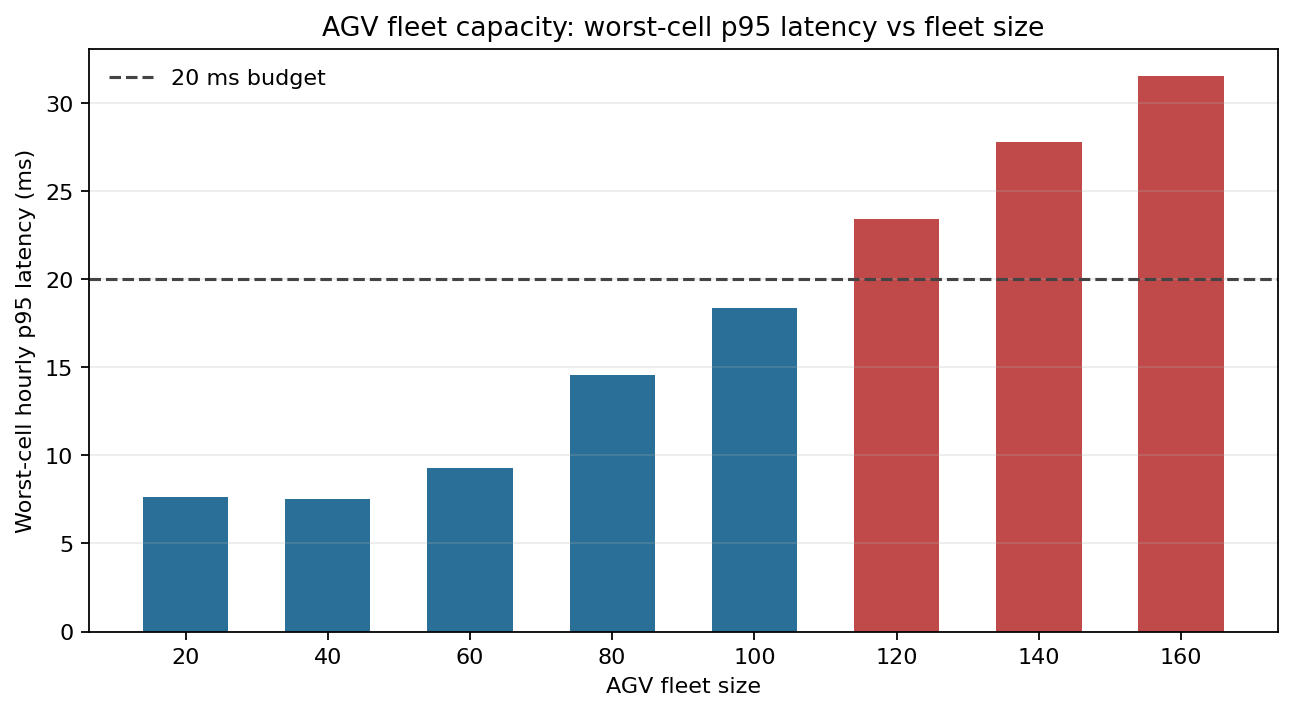
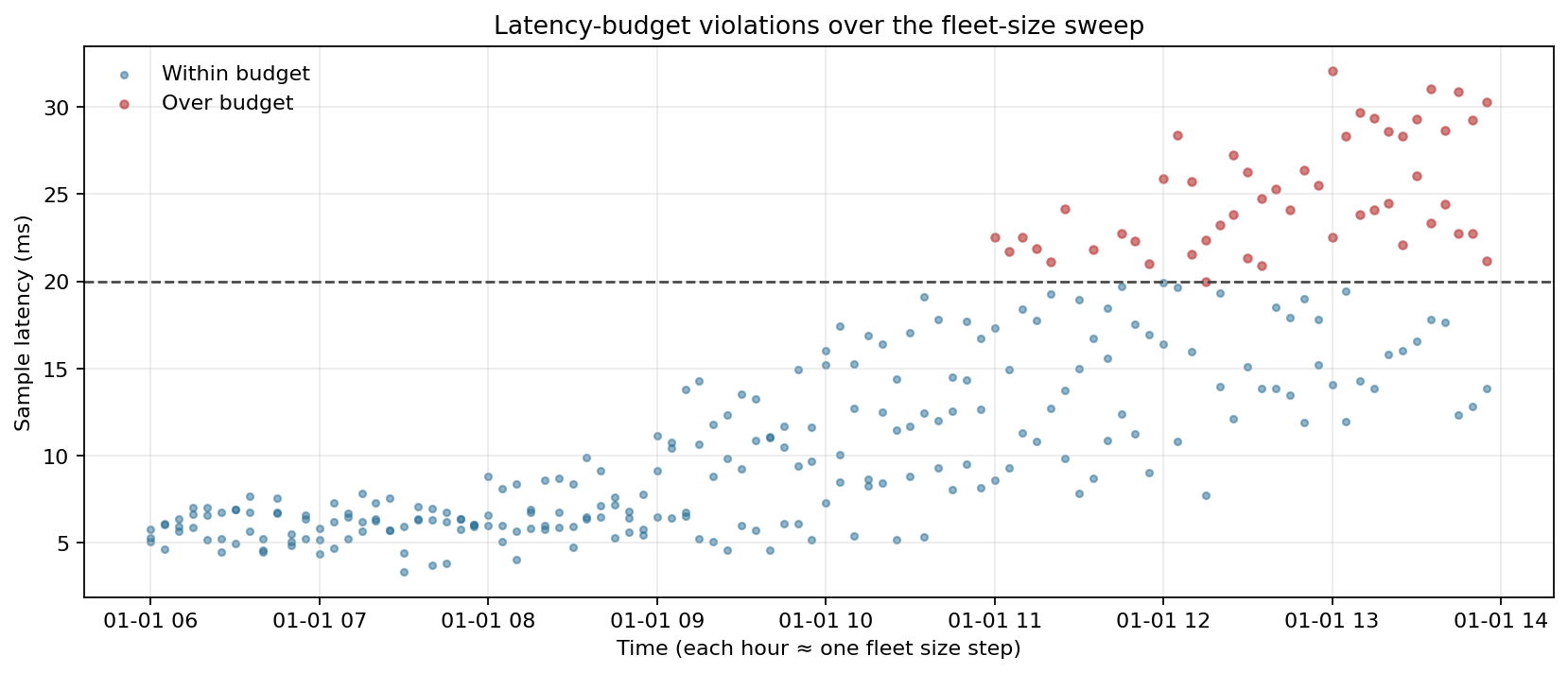
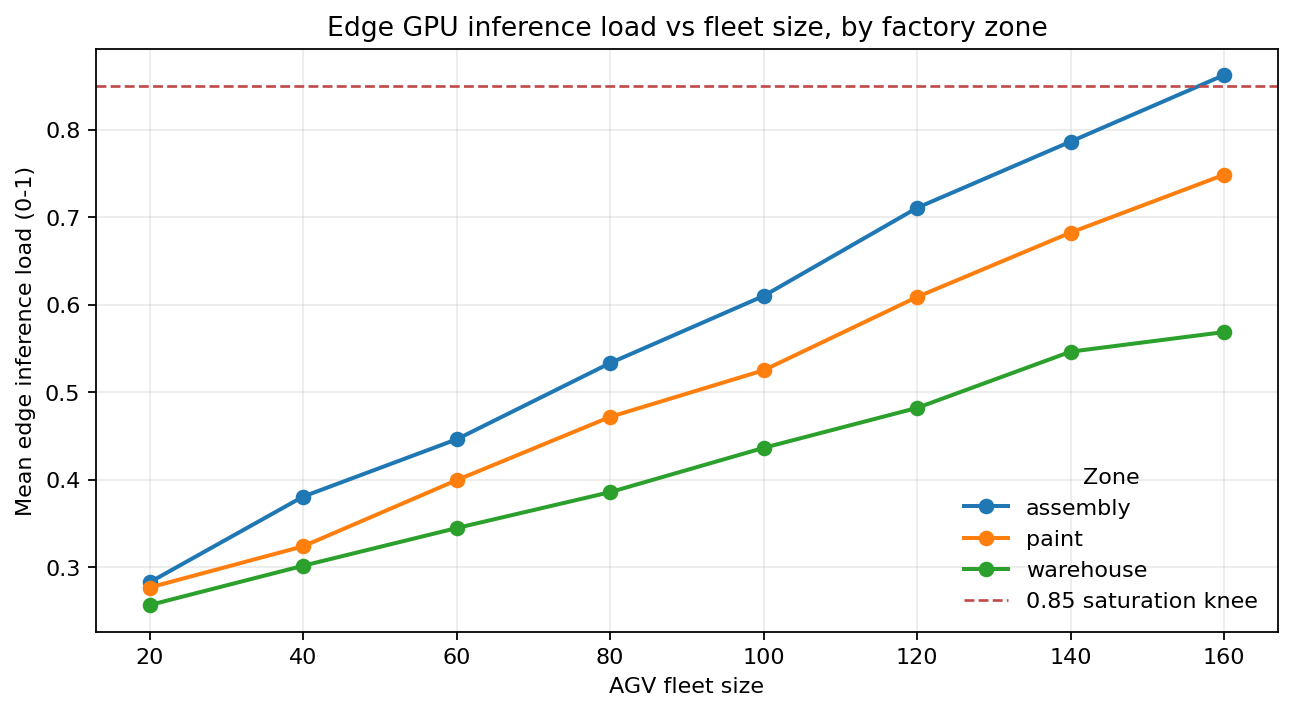
The simulated floor stayed under budget through 100 AGVs. At 120 AGVs, the budget broke. The first constraint was not simply radio capacity; assembly-zone edge GPU saturation appeared first in the seeded outputs.
That changes the decision: cap expansion at 100 AGVs, rebalance assembly-zone workload, reserve edge GPU capacity before testing 120 AGVs, and validate with live RAN and GPU telemetry before any real deployment decision.
Start here
Executive dashboard
Open the operator console first. It answers the AGV capacity question, shows the first unsafe expansion point, attributes the likely bottleneck, and keeps deployment boundaries visible.
ceiling: 100 AGVsbudget: 20 ms
Manufacturing decision
AGV capacity and 20 ms budget
The seeded manufacturing sweep keeps worst-cell p95 latency under 20 ms through 100 AGVs. The first tested unsafe expansion point is 120 AGVs.
recommended ceiling: 100 AGVsfirst unsafe: 120 AGVs
Bottleneck evidence
Edge GPU / worst-cell p95 analysis
Manufacturing evidence links the 20 ms breach to worst-cell latency growth and simulated edge-load pressure in the assembly zone. This is a likely bottleneck candidate, not live factory attribution.
Secondary portability
Pharma scenario
Secondary portability scenario, not the headline use case. It shows the same pipeline shape on a seeded bioreactor anomaly simulation; it does not use real pharmaceutical plant telemetry.
lead time: 5 minprecision: 1.00
Pipeline evidence
Schema validation, quarantine, deterministic generation
The telemetry layer validates schema, fails soft into quarantine for bad rows, and regenerates deterministic seeded artifacts through the same static report flow.
Benchmarks and CI
Performance and reproducibility proof
Benchmarks focus on telemetry-pipeline evidence: ingest throughput, quarantine throughput, end-to-end regeneration time, and deterministic artifact hashes.
Boundaries
What this project does not claim
No live private 5G network, no vendor RAN integration, no MES/SCADA/PLC connector, no safety certification, no production runtime claim, and no real AGV fleet telemetry.
Business case
Capacity decision brief
A direct business-case note for the practical decision: avoid unsafe AGV expansion, avoid buying the wrong capacity layer first, and validate headroom with live telemetry before deployment.
Start here
One-page brief
Both buyer stories side-by-side, the answers, the sensitivity, what I tested, and what I did not claim. Five minutes to read for an engineering leader or executive who wants the shape of the work before going deeper.
What I tested, what I didn't
Every number on this page comes from a seeded simulation. I didn't connect to a live private 5G network, vendor RAN, vendor edge-AI platform, MES, SCADA, PLC, or a real AGV fleet. What's portable is the schema, the scenario pattern, and the way the capacity answer comes with its sensitivity story attached.