Headline evidence
Five KPIs at a glance — model quality, test coverage, and the honest disclosure that the channel classifier is weak on this feature set. Jetson latency is not yet measured; the benchmark template is ready when hardware lands.
Engineering decision summary
The dashboard readout in six decisions: what worked, what failed, what is deployment-ready, and what still needs hardware validation.
Link adaptation result
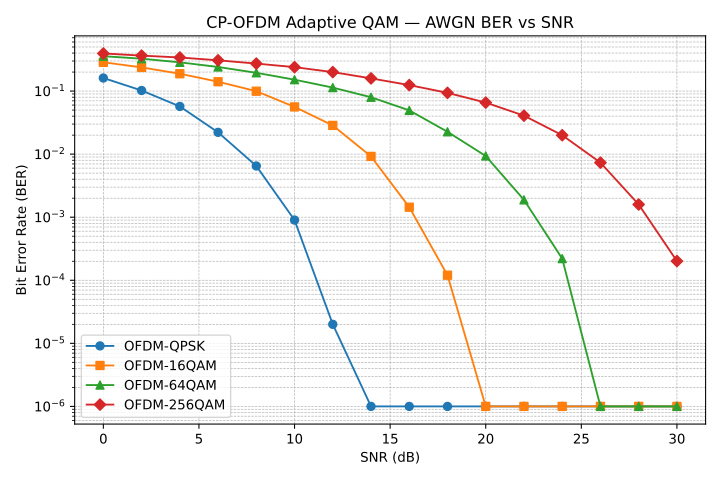
Higher-order QAM increases bits per symbol but pushes the BER floor to higher SNR; QPSK clears the 1e-6 simulation floor far earlier than 64/256-QAM.
Multipath stress result
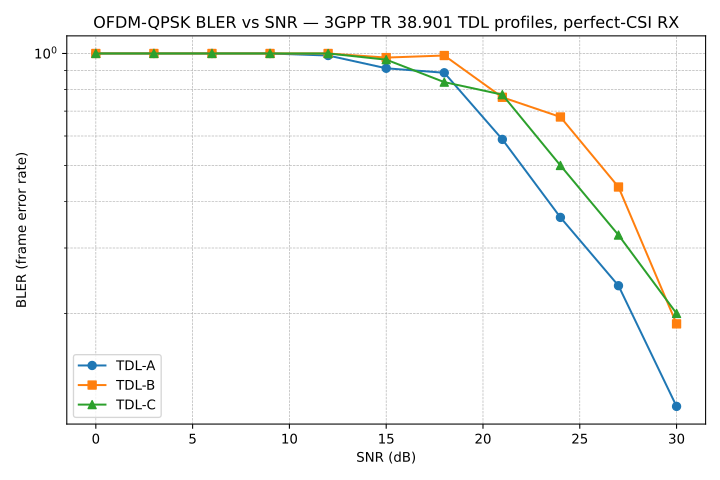
TDL BLER remains 11.2%-20.0% at 30 dB; the diversity-1 perfect-CSI receiver still needs coding/HARQ/MIMO to become a production link.
Estimator result
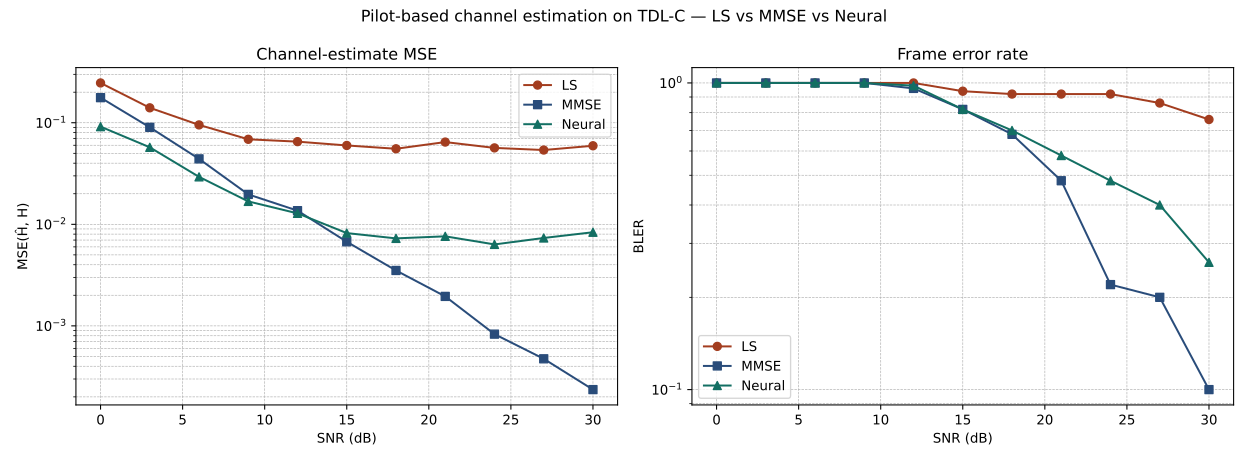
Neural denoises best at low SNR, MMSE wins once priors dominate at high SNR, and LS is the transparent baseline.
Edge deployment result
ONNX INT8 gives about 3.3x CPU latency speedup with sub-0.01 dB MAE drift against FP32 ONNX.
Weak result
Channel classifier accuracy is 0.472; current constellation statistics estimate SNR/BER well but do not separate AWGN vs Rayleigh reliably.
Hardware validation status
Jetson template is ready; no hardware latency is claimed until benchmark JSON exists.
Honest boundaries
Scope boundary: ML data is synthetic; the receiver is a simulation testbed, not production PHY; LDPC, HARQ, MIMO, and scheduler validation are not implemented; Jetson latency remains pending unless reports/jetson_inference_benchmark.json exists; channel classifier accuracy is weak and disclosed.
Link reliability tiers
Operational interpretation of the CP-OFDM AWGN BER curves. Thresholds are deterministic and intentionally simple: Excellent BER <= 1e-6, Usable <= 1e-3, Degraded <= 1e-2, Unreliable above that. TDL BLER is frame-level under diversity-1 perfect-CSI simulation, so it is interpreted separately as a multipath stress test, not an SLA.
| Modulation | Excellent | Usable | Degraded | Unreliable below |
|---|---|---|---|---|
| OFDM-QPSK | 14 dB | 10 dB | 8 dB | < 8 dB |
| OFDM-16QAM | 20 dB | 18 dB | 14 dB | < 14 dB |
| OFDM-64QAM | 26 dB | 24 dB | 20 dB | < 20 dB |
| OFDM-256QAM | not reached | 30 dB | 26 dB | < 26 dB |
Methodology
Everything below is regenerable by make verify from a fresh clone. Synthetic dataset for the ML layer; classical BER curves are verified against textbook predictions.
| PHY modem | CP-OFDM, 64 subcarriers, CP=16, Gray-coded square QAM (M = 4 / 16 / 64 / 256) |
|---|---|
| Channel models | 3GPP TR 38.901 TDL-A / TDL-B / TDL-C (Tables 7.7.2-1/2/3, NLOS multi-tap, ensemble-averaged Rayleigh) |
| Single-carrier baseline | QPSK over AWGN (1M bits) + flat Rayleigh ensemble (N=200 × 10k bits) |
| Channel convention | Transmit-power-SNR — verified (|h|² fade penalty does not cancel out) |
| Channel estimation | Pilot-based — LS / MMSE (exponential PDP prior) / Neural (PyTorch MLP) compared head-to-head on TDL-C |
| Link-estimation ML dataset | Synthetic 12-feature CSV — 500 samples, 125 stratified holdout (no oracle leakage; see AGENTS.md hard rule #1) |
| Edge deployment | PyTorch → FP32 ONNX → INT8 ONNX (dynamic PTQ via onnxruntime.quantization) |
| Validation harness | 77 pytest tests, ruff lint, CI matrix on Python 3.11 + 3.12 |
Adaptive QAM — CP-OFDM BER vs SNR (AWGN)
QPSK / 16-QAM / 64-QAM / 256-QAM on a 64-subcarrier CP-OFDM modem. Same Gray-coded square constellation logic across all four orders, normalised to unit average symbol energy. The curves below match textbook 5G NR link-adaptation tables — what a scheduler reads to pick MCS from CQI feedback.
Engineering readout: Adaptive modulation behaves as expected: QPSK is robust at low SNR, while 64/256-QAM need much cleaner channels. That makes this section the link-adaptation baseline, not a claim about production NR scheduling.
BER at fixed SNR points (AWGN)
| Modulation | 0 dB | 6 dB | 12 dB | 18 dB | 24 dB | 30 dB |
|---|---|---|---|---|---|---|
| OFDM-QPSK | 1.61e-01 | 2.22e-02 | 2.00e-05 | < 1e-6 | < 1e-6 | < 1e-6 |
| OFDM-16QAM | 2.86e-01 | 1.41e-01 | 2.85e-02 | 1.20e-04 | < 1e-6 | < 1e-6 |
| OFDM-64QAM | 3.57e-01 | 2.41e-01 | 1.13e-01 | 2.26e-02 | 2.20e-04 | < 1e-6 |
| OFDM-256QAM | 3.94e-01 | 3.07e-01 | 2.00e-01 | 9.36e-02 | 1.99e-02 | 2.01e-04 |
Reading the table: higher-order QAM packs more bits per symbol but needs higher SNR to recover them. 256-QAM still has BER 2e-4 at 30 dB; QPSK is below the 1e-6 simulation floor by 6 dB. This is exactly the trade-off behind the CQI → MCS table.
3GPP TR 38.901 TDL channel BLER — perfect-CSI receiver
Ensemble-averaged frame error rate under TDL-A / TDL-B / TDL-C (NLOS multi-tap fading from TR 38.901 §7.7.2). Each (profile, SNR) point averages 80 independent channel realisations × 4096 bits with perfect channel-state information at the receiver. BLER pinned at 1.0 below 12 dB and only 10–20 % at 30 dB is the honest diversity-1 multipath result — exactly why real 5G uses LDPC + HARQ + MIMO on top.
BLER at fixed SNR points
| Profile | 0 dB | 6 dB | 12 dB | 18 dB | 24 dB | 30 dB |
|---|---|---|---|---|---|---|
| TDL-A | 1.000 | 1.000 | 0.988 | 0.887 | 0.362 | 0.113 |
| TDL-B | 1.000 | 1.000 | 1.000 | 0.988 | 0.675 | 0.188 |
| TDL-C | 1.000 | 1.000 | 1.000 | 0.838 | 0.500 | 0.200 |
TDL-B has the widest delay-spread power → harder for the per-subcarrier equaliser to keep up. TDL-C is the "typical urban NLOS" reference used across the AI-PHY literature.
Pilot-based channel estimation — LS vs MMSE vs Neural (TDL-C)
All three estimators see the same TDL-C realisations and the same noisy received pilots (comb stride 4). The neural estimator is a small PyTorch MLP trained on ~2,500 synthetic frames covering −5 to +30 dB. Reading: neural wins at low SNR (better denoising than linear interpolation or the closed-form MMSE prior), MMSE wins at high SNR (optimal given known noise variance + delay-profile prior), LS lags everywhere. This is the textbook AI-PHY trade-off — surfaced, not polished away.
Channel-estimate MSE at fixed SNR points
| Estimator | 0 dB | 6 dB | 12 dB | 18 dB | 24 dB | 30 dB |
|---|---|---|---|---|---|---|
| LS | 2.466e-01 | 9.523e-02 | 6.518e-02 | 5.545e-02 | 5.656e-02 | 5.936e-02 |
| MMSE | 1.767e-01 | 4.407e-02 | 1.363e-02 | 3.510e-03 | 8.288e-04 | 2.356e-04 |
| Neural | 9.151e-02 | 2.933e-02 | 1.282e-02 | 7.269e-03 | 6.339e-03 | 8.354e-03 |
The left plot shows both MSE and resulting BLER side-by-side. Neural is competitive vs MMSE without needing the noise-variance / delay-spread priors — that's the DeepRx-pattern signal: a learned estimator that closes the gap to the analytical optimum.
FP32 → INT8 ONNX quantization (SNR estimator)
Same model, three deployment forms: PyTorch FP32 (training native), ONNX FP32 (portable), ONNX INT8 (dynamic post-training quantization via ONNX Runtime). The honest trade-off: ~3.3× CPU latency reduction and ~1.9× smaller file with sub-0.01 dB accuracy drift. This is the standard edge-AI pipeline that lands on Jetson, BlueField, or any TensorRT-backed inference target.
| Form | Holdout MAE (dB) | File size | CPU latency (µs / sample) |
|---|---|---|---|
| sklearn baseline | 0.0746 dB | — | — |
| PyTorch FP32 | 0.2869 dB | — | (in-memory) |
| ONNX FP32 | 0.2869 dB | 12,445 B | 46.11 |
| ONNX INT8 (dyn PTQ) | 0.2798 dB | 6,487 B | 13.77 |
Dynamic INT8 quantisation typically incurs <0.05 dB MAE drift on a small MLP regression task. The expected payoff is ~3-4× smaller model file and ~1.5-3× faster inference on CPU. Latency on Jetson AGX Thor is reported separately in reports/jetson_inference_benchmark.json.
Jetson AGX Thor benchmark — hardware-ready
Pending measurement. The ONNX FP32 and INT8 models are exported, the benchmark template is ready, and the Jetson AGX Thor is in hand. Latency p50/p95/p99 will land here after a 30-second run on the device — see
JETSON_BENCHMARK_GUIDE.md for the exact commands. Until then this row is honestly labelled <TO MEASURE>.
BER vs SNR — single-carrier QPSK baseline
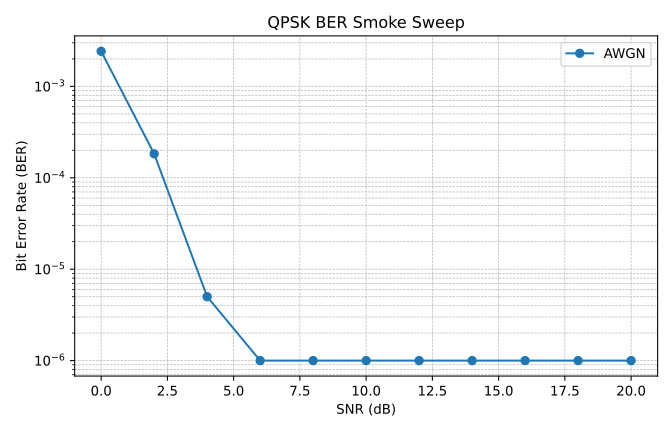
AWGN: 1M-bit deterministic sweep. Rayleigh: ensemble-averaged N=200 realizations × 10,000 bits per SNR point, using the transmit-power-SNR convention so the diversity-1 penalty is visible (BER falls roughly as 1/SNR_linear), not cancelled by the |h|² factor at the receiver.
AWGN — full sweep (1M bits)
| SNR | BER |
|---|---|
| 0 dB | 2.42e-03 |
| 2 dB | 1.83e-04 |
| 4 dB | 5.00e-06 |
| 6 dB | < 1e-6 |
| 8 dB | < 1e-6 |
| 10 dB | < 1e-6 |
| 12 dB | < 1e-6 |
| 14 dB | < 1e-6 |
Rayleigh — ensemble averaged (N=200 × 10k bits)
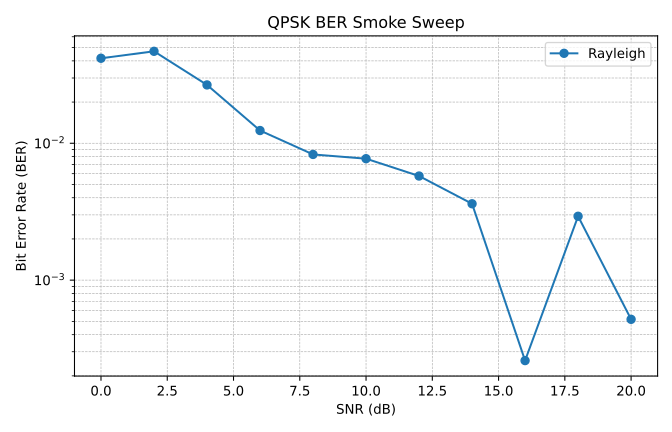
| SNR | Avg BER |
|---|---|
| 0 dB | 4.18e-02 |
| 2 dB | 4.70e-02 |
| 4 dB | 2.67e-02 |
| 6 dB | 1.24e-02 |
| 8 dB | 8.29e-03 |
| 10 dB | 7.72e-03 |
| 12 dB | 5.77e-03 |
| 14 dB | 3.61e-03 |
ML link estimators — holdout performance
Four estimators trained on the synthetic link-condition CSV with a 25% stratified holdout. The channel classifier's weak accuracy is reported, not hidden — see the per-estimator interpretation below.
| Estimator | Primary metric | Secondary |
|---|---|---|
| SNR estimator | R² 0.999 | MAE 0.1181 |
| BER predictor | R² 0.968 | MAE 0.0005 |
| Channel classifier | acc 0.472 | (below majority-class baseline) |
| Link-quality scorer | R² 0.904 | MAE 4.0886 |
What each estimator is doing — and where it fails
Per-estimator interpretation in plain English. Each card includes the calibrated finding (what this model captures, why, and where the boundary is).
SNR estimatorR² 0.999
The constellation power and spread tell you SNR directly — clean features (rx_power_mean, evm_rms, radius_std) make this nearly deterministic on synthetic data. On a real receiver this is the estimator that runs every frame to drive AGC and modulation-and-coding-scheme decisions.
BER predictorR² 0.968
BER follows from SNR via the Q-function in theory, but at low SNR the constellation spread carries information the textbook formula misses. Predicting measured BER directly from constellation statistics catches both — the residual error is well below the simulation resolution floor on this dataset.
Channel classifieracc 0.472
Honest weak result. AWGN and Rayleigh produce similar constellation statistics when averaged over symbols — distinguishing them needs higher-order features (envelope variance over time, autocorrelation) the current 12-feature set does not have. Accuracy below the 0.5 majority-class baseline is the calibrated signal that this task wants a different feature design; surfaced rather than hidden.
Link-quality scorerR² 0.904
The 0–100 link-quality target combines SNR and BER with a small Rayleigh penalty. The model recovers it well because SNR and BER are already strongly predicted — this estimator is more a consistency check than a new capability.
Engineering quality signals
Repo discipline that you can verify in 60 seconds from a fresh clone.
Tests
77 / 77
pytest -q
Lint
clean
ruff check .
CI matrix
3.11 + 3.12
.github/workflows/ci.yml
End-to-end repro
one command
make verify
Limitations
What this is not: a production telecom receiver, an AI-RAN base station, a standards-compliant modem, or a scheduler. The ML dataset is synthetic. The Jetson row is <TO MEASURE> until hardware lands. The channel classifier's 0.472 accuracy is below the majority-class baseline — disclosed as a calibrated weak result, not hidden behind aggregate F1 numbers.